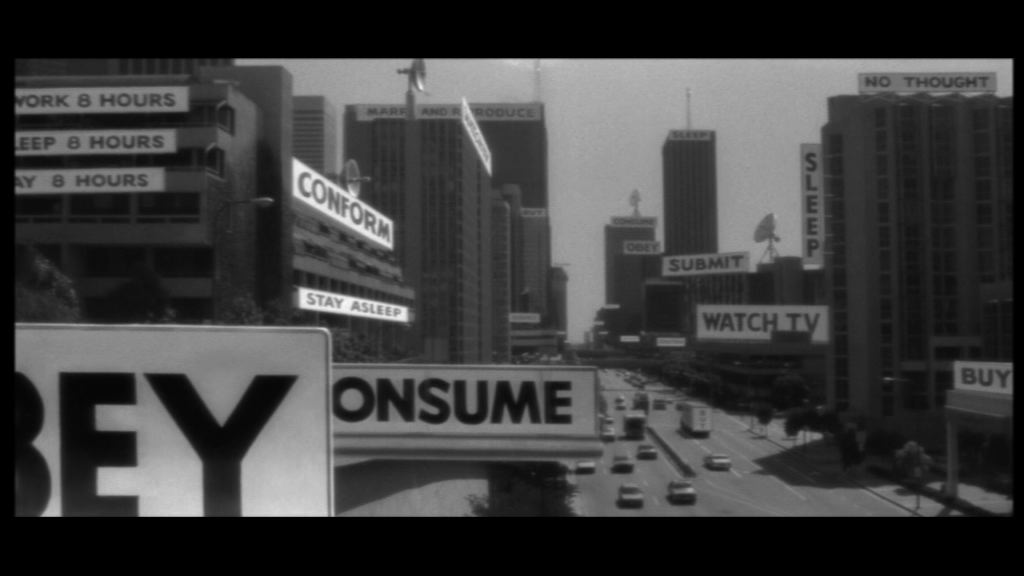
The main problem with Althusser's theory for Ranicere is this:
[I]deology for Althusser is quite capable of possessing the same status as that conferred on the State by classical metaphysical thought. And his analysis is capable of reinstating the myth of an ideological state of nature...Ideology is not seen from the start as the site of struggle. It is not related to two antagonists but to a totality of which it forms a natural element.
I remember reading the ISA's essay in high school and being utterly baffled. I remember reading it last year in Western Marxism, and after going over my notes, Althusser seemed then to have offered a much more rigorous and cogent method for systematically engaging the paradoxes surrounding the problem of false consciousness, who's doing the duping, is it more than or other than mere duping, what's the role of desire and so on. But I also remember staring at sentences being utterly confused, such as the one on the question of stepping outside of ideology. I found reading the essay this year to be much easier, yet it did not sit well with me. The turbulent cascading of new publics, the over-saturation of ideological content, the hybridization of both content and the relations of knowledge production etc.. lead me ot believe that Marxist criticism cannot transcend the contemporary relations of production if it remains solely a question of the proper, scientific interpretation of the entire unfolding of events, of the revolutions, and their repression, before your eyes. One need not repeat Thesis 11, to Althusser it was tainted by a humanist naivete.

I don't think Althusser necessarily deserves as harsh of a treatment as Ranciere does, but the wellspring of Ranciere's vitriol also produced some more rigorous gems. By turning ideology into a natural element of man's environment, Althusser effectively conceals the profoundly basic determination of class antagonism - the relationship between labourers and non-labourers is what has characterized and determined all societies at their most basic level; granted the ways in which this determination occurs changes in accord with the evolution of societies.
Althusser takes the function of the dominant ideology to be the function of Ideology. By understanding Science as the Other of Ideology, Althusser reduces the class struggle to vigilante criticism. Even if this is hyperbolic, or wrong, or unscientific in reference to Althusser, I don't think its wrong to say that those who adopt the more orthodox or structuralist forms of ideological criticism are far better at saying no, than nodding yes, than affirming a sacred yea-saying, than tasting the ecstasy of communion. Paranoia runs deep within Marxist veins, the cultural critics are like a weird, warped reflection of Ron Paul - only less witty.
By a process which detaches ideology form the system of instances, and erases the main division of the ideological field to create a psace in Marxist theory which it then shars out between science and ideology. The functioning of the Science/Ideology opposition depends on the re-establishment of a space homologous to that which the whole metaphysical tradition assumes by opposing Science to its Other; thus supporting the closure of a universe of discourse, divided into the realms of the true and the false, into the world of Science and that of its Other (opinion, error, illusion, etc.). If one fails to grasp that ideology is fundamentally the site of struggle, of a class struggle, it immediately slips into this place determined by the history of metaphysics: the place of the Other of Science (Ranciere, 4).
Studying the Althusserian theory of
ideology demands a return to’68, when the question of the University provided
the best teaching lesson that ever filled those lecture halls. Althusser’s work
surged like Santorum in the wake of the ‘failures’ of ’68. The lack of a
structured transition from spontaneous revolt to proper class organization was
diagnosed as symptomatic of a lack in theoretical adequacy in the understanding
of the Marxist paradigm; and Althusser’s scientific theoreticism seemed to
satisfy the desire.
Many
however have taken up arms against the revisionist and metaphysical
tendentiousness of Althusser, but more so of his immediate followers. Jacques
Ranciere very notably attacked the theory, by describing the ways in which
Althusser’s general theory of Ideology depoliticizes and conceals the
fundamental origin of ideology; and in its worst forms supplies the fodder for
“the ideological counter-revolution” (10).
In the 1973 afterword to Ranciere’s
1969 essay “On the theory of ideology (the politics of Althusser)” he even goes
as far as saying that the re-approprations of Althusser’s metaphysics led to “A
creation of neither working class consciousness, nor Marxist theory, but of the
Stalinist State machine” (12).
The ‘lessons of May’ deduced a
binary between ideology and science, and subsequently bourgeois and proletarian
ideology , that represented the terrain of ideological struggle as posed
between two homogenous entities, which were in reality quite heterogeneous.
It is a system of
power relations that is always fragmentary because it defines a certain number
of conquests always provisional because it is not produced by the apparatuses
but by the development of struggle (12).
The
Althusserian operation of applying class analysis ‘in the last instance’
discloses the cunning of capitalist reason as a desubjectified operation of a
structure in general, an explicitly inhuman analysis which reduces Marxist
criticism to an empty formalistic exercise defined according to scientific
standards of ‘bourgeois rigor;’ an academic exercise which ultimately voids the
class struggle of its lifeblood.
Proletarian
ideology is neither the summary of the representations or positive values of
the workers, nor the body of ‘proletarian’ doctrines. It is a stopped
assembly-line, an authority mocked, a system of division between particular
jobs of work abolished, a mass fight-back against ‘scientific’ innovations in
exploitation, and it is the ‘bare-foot doctor’ or the entry of the working class into the Chinese university. Mass
practices produced by the anti-capitalist struggle whose uniqueness is missed
as soon as one tries to set a proletarian philosophy, justice or morality
against the philosophy, justice or morality of the bourgeoisie (12).
While Ranciere admits his analysis
was deliberately one-sided, there are many beneficial attributes of Althusser’s
insights into the nature of ideology, but more on that later.
Convergence Culture is the inauguration of a new era in consumption and production – like all of Capital’s epochal changes, its movement is caused by a confluence of forces, “technological, industrial, cultural and social”(3). Convergence is not just a congregation but also a collision, the contradictions between new and old, grassroots and corporate, and consumer and producer grow ever more complex. Jenkins toes the threshold between the pious followers of the Convergence cult and the unwavering dogmatism of “critical pessimists”(258). Convergence Culture is not necessarily good or evil, just potentially dangerous, Jenkins’ critical utopianism resists the view of technological determinists, “rather, convergence represents a paradigm shift – a move from medium specific content toward content that flows across multiple media channels, toward the increased interdependence of communications systems, toward multiple ways of accessing media content” and increasingly “complex relations between corporate media and bottom-up participatory culture”(254). The changes in media technologies generate new consumption habits, the postmodern economy is not limited to the old marketing strategies and essentialist identity formations but caters to niche markets. American Idol and The Matrix are examples of “affective economics” in which “the line between entertainment content and brand messages” are blurred (20). The transformation of brands into “lovemarks” entails a shift from passive to “active, emotionally engaged, and socially networked” consumers that produce, an example of how the medium becomes the message (20). The Matrix, Star Wars, and Harry Potter, all fantastic or fictional stories have succeeded in “transmedia storytelling”(93). Jenkins discussion of political coverage and news media’s cyber-interfaces shows “participatory culture’s power to negate” as well as “old media’s power to marginalize”(278). Ultimately, Jenkins think that “increasing participation in popular culture is a good thing,”(259) a progressive tool that will lead to “a more ideal society”(258). How we will get there and what technologies will be the machinery of resistance is a question for the democracy-to-come.
Jenkins Playing Guitar Hero
In the end Jenkins accomplished the goal of his book, which was necessary but insufficient. Jenkins never claimed to possess all of the answers or that he had a specific politics embedded besides his basic normative claim that communication and popular culture are good activities. Jenkins' focus on the way culture circulates rather than is produced lacks a theoretical framework for evaluating competing claims. The substance of Jenkins’ method of critique has become as virtual as his object of study. Granted dogmatism is a vice, but Jenkins merely seeks out the possibilities of "consumer-based politics"(260). The only discussion of the "process (expanding access to the means of media production and distribution)" is posed as an offhanded question (252). Should we really expect any fundamental change in the marketplace if we are only focused on the products created rather the method by which they were given life? Does the liberatory potential of Convergence Culture, within the economic realm anyway, simply mean the expansion of marketing strategies to better assimilate the diversity of identities, social niches, idiosyncratic consumption behaviors etc..? Jenkins vision of empowerment mystifies an ideological background of exploitation. He attacks the symptom of a process that exceeds his object of concern. Unless you criticize the fundamental structuring principles of media culture one will only end up putting a human face upon one facet of larger systemic forces of irrational violence and destitution. Jenkins is right that convergence culture cannot be dealt with through an all or nothing approach, but bracketing the discussion to how to make corporations respond better to consumer preferences is ultimately an even more disempowering and cynical way of relating to one's own role as a critic and a consumer. It fulfills our desire to conceive of capital as a rational system, that if only we have more information about the products created we can reconcile its contradictions. It feeds the fantasy that if corporations knew what we really wanted they'd make it for us. But this evades the stark reality of the culture industry; the culture industry does not just rationally respond to people's clear-cut demands, but rather produces desires and proliferates them through a leveling process.