Person(a) of the Year

Although the selection of a persona or group
based identification rather than a specific individual is not a new development
for TIME; this year's selection of "The Protester" points toward intriguing
new developments in the dynamics of global publics. TIME Magazine’s selection criterion
is rather simple; the award goes to that person, group, or concept which most
influenced the news, for better or for worse.

Why “The Protester”? Why not the singular
Tunisian fruit vendor; the spark that spurred a fire that would rapidly proceed
to engulf the globe; from the favelas of the south to the arctic blasted
Russian metropolises, and the most developed countries in the world? Why not
choose even a specific group of protesters, “The Arab Spring” or the #OWS
movements?

Here’s portion of TIME Magazine’s defense of
their selection:
Everywhere this year, people have complained about the failure of traditional leadership and the fecklessness of institutions. Politicians cannot look beyond the next election, and they refuse to make hard choices. That's one reason we did not select an individual this year. But leadership has come from the bottom of the pyramid, not the top. For capturing and highlighting a global sense of restless promise, for upending governments and conventional wisdom, for combining the oldest of techniques with the newest of technologies to shine a light on human dignity and, finally, for steering the planet on a more democratic though sometimes more dangerous path for the 21st century, the Protester is TIME's 2011 Person of the Year.
News by definition is generated from
controversy. News is a form of protest against the status quo; it pokes holes
in the previously seamless fabric of the present. In re-presenting the facts of
what has occurred the news defies expectations of what we thought was
occurring. But news is also analysis, opinion, and commentary on how we should
relate ourselves to new developments; as they emerge in real-time. News even offers
analysis on the news. And other media offer analysis on the analysis of the
analysis. Entertainment, factual presentation, commentary and opinion become
ever blurred in the era of Meta-news.
Yet the news has also donned the mask of the figure of the “The Protester” in
response to the “The Protester” itself, in its myriad forms.


And in a sense,
TIME Magazine is all too aware of this phenomenon. In the penultimate statement
defending their decision, TIME reflects on the affective capacities that “The
Protester” generated:
For capturing and highlighting a global sense of restless
promise
The criterion
for selection is fundamentally based on the influence a person/group/concept has had on the media. The reason “The Protester” was so influential was because it
fostered the conditions of possibility that connected, created and fed
unpredictable desires. There was something else at work in the figure of
“The Protester” this year. The figure itself always already was a figure that
embodied influence. In a sense every TIME Magazine Person of the Year recipient
embodies the figure of “The Protester” in one-way or another.


But there are also very specific figures that are emblematic of “The
Protester.” There is the Tunisian Fruit Vendor, the romanticized figure of
self-sacrifice and ineffable defiance of conventional wisdom. There are the
#OWS protesters, the leaderless and organic network of protesters, but a more
contentious figure, admired, mockupied and demonized all at once. Within the
Occupy Wall ST. Movement the most famous representatives are the victims; the NW
Grandma and UC Students Pepper-sprayed, the Iraqi War Veteran whose skull was
fractured by Oakland Policy with a tear gas canister, or countless others who
were subjected to police brutality.
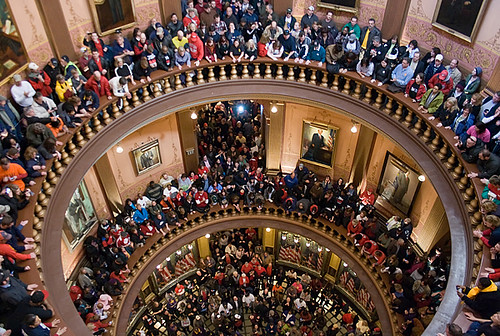
I posted during the first few months of the #OWS protests about the
statistical connection between acts of police repression and media coverage of
the protests. There was a significant positive correlation between instances of
state violence and the amount of media traffic consumed by global publics; thus
its no surprise that the most well known figures are the victims.
Yet TIME Magazine repeatedly insists on the fact that this revolution was not linearly caused by advances in technology:
Technology mattered, but this was not a technological revolution. Social networks did not cause these movements, but they kept them alive and connected. Technology allowed us to watch, and it spread the virus of protest, but this was not a wired revolution; it was a human one, of hearts and minds, the oldest technology of all.
Is there a global tipping point for frustration?
To me the more interesting question is not whether there is a tipping
point or brink in terms of the numbers of people that have to be frustrated
before general sentiment translates into action; or whether there is a brink in
terms of how pissed people have to get before an emotion becomes an occupation.
Instead, what if technological
prosthesis expands our collective affective horizon of possibility? Or if there
were a brink, what if it were not fixed or timeless? What if we could actively
work on finding ways to lower or raise its threshold? Or return to a more
ancient education of the sense? In so many ways (that need not be repeated
here) the sources and levels of frustration within the varying contexts (from
#OWS to the Arab Spring, to Russia and Greece) differed dramatically, yet
tactics by the different groups were remarkably similar. This movement emerged from and continues to generate a social imaginary; an envisioning that feeds forwards and backwards through the public , other movements and the prefigured present; like an electric charge. The
bonds of solidarity sedimented through millions of bytes in the bucket spurred
passionate attachments to the trajectories of other protesters and movements.
The interconnectedness of the movements provided an infrastructural base that
would outpace its wildest dreams.
The movements
combine:
the oldest of
techniques with the newest of technologies to shine a light on human dignity
A technique of
the self;
A prosthetically
enhanced capacity to respond;
An augmented
duty to own up to one’s ownmost potentiality for respons(e)ibility.
Labels: #OWS, Affective economies, Arab Spring, Aristotle, cyber rhetoric, Cyberhetoric, Emotion, Ethos, global publics, Mediacology, Neurophilosophy, New Media, Prosthesis, The Protester, Time Magazine Person of the Year
posted by Unknown @ 6:36 AM
0 Comments