< !DOCTYPE html PUBLIC "-//W3C//DTD XHTML 1.0 Strict//EN" "http://www.w3.org/TR/xhtml1/DTD/xhtml1-strict.dtd">

This page has moved to a new address.

< $BlogTitle$>

Thursday, May 5, 2011

A Cluster of Promises

A budget is more than just a budget. A budget is a piece of legislation, a policy text, a material force of governance – this is true. But a budget is also the enactment of a cluster of promises, a calculus of social values, threats and opportunities, debts and gifts. The budget debate occurs within an anticipatory and expectant space on the horizon of past and future imaginaries. The debt is an historical residue of exchange relations that persist in the present. Yet the memory work required to break down the behemoth of the budget into manageable chunks actively and selectively forges a link to a future that is not-yet.
In “The Country We Believe In” speech Obama remarks, “This debate over budgets and deficits is about more than just numbers on a page, more than just cutting and spending. It's about the kind of future we want. It's about the kind of country we believe in.” Obama first calls the citizen subject to conceive of the budget not in terms of its particular material effects but based on how we, as a country, orient ourselves toward the future. A further implication of this statement lies in its implicit acknowledgment that budgets exist through multiple generations. The debate beckons citizens to locate themselves within the larger context of the entire process of reproducing society.
This appeal has two functions. First, for the Left it displaces all of the blame placed on them by attributing much of it to the past. Secondly, it opens up the future to a question of desire rather than determination. In an essay on hope and technology Ben Anderson discusses the ways that “governance works through and modulates affects.” Anderson warns that before one can establish “a single collective mood to this or any other geo/bio-political present” one should attune to the ways that virtualities work in relation to affects. Drawing on Massumi’s theory of affect, Anderson writes, “Affect is a necessary component of anticipatory governance because it resolves the paradox of how the event can remain virtual, that is ‘be’ a threat or an opportunity, but at the same time is real in effect, i.e. it causes some form of event in the present.” Objects of hope or risk have to be embedded within a network of relations between “anticipatory epistemic objects – such as scenarios -that function to create what Massumi terms ‘affective facts.’”(Anderson) hope circulates “as an unstable object of governance” in the dramatization of the debt crisis because it refers to something that does not yet exist. The contours of the future’s form are yet to be imagined.
When affects are freed from referents they can circulate and thus accumulate force so freely that they can be redeployed to undermine their initial cause. Ahmed writes, “To declare a crisis is not “to make something out of nothing”…But the declaration of crisis reads that fact/figure/event and transforms it into a fetish object that then acquires a life of its own” (132). The crisis becomes a thing that grows larger than the sum of its parts. “Through designating something as already under threat in the present, that very thing becomes installed as “the truth,” which we must fight for in the future, a fight that is retrospectively understood to be a matter of life and death.” (132) The baby-boomers and the babies yet to be born are the main currency within the budget debate’s affective economy.
Representative Ryan makes parallel appeals to futurity in his description of the larger implications of the budget, “It is not just a budget – it is a cause. It represents our choice for America’s future, and our commitment to the American people” (Ryan). The rhetoric of ‘commitment,’ ‘responsibility,’ and ‘austerity’ emphasizes the need to have a specific subjective comportment in our relationship to the policy problem at hand. The budget debate is so laden with affect because it explicitly exposes the dialectic between discipline and desire. The budget is a problematic object because it attempts to strike a balance between multiple kinds of debts. There is a debt to suture past wounds, a debt to the suffering in the present, and a debt to ensure an equal, if not better, opportunity for future generations. But there’s also an obligation to principles, morality and character;
These budget debates are not just about the programs of government; they're also about the purpose of government. This is a future in which we will transform our social safety net into a hammock, which lulls able-bodied people into lives of complacency and dependency.

This excerpt from Ryan’s speech shows how our imaginings of a future have an effect on the types of subjectivities that will be produced. The GOP is not just defining their strategy in opposition to the excesses and waste of the budget, but appeal to the loss of creative potentials that will occur. The budget’s temporality exposes the ways that subjectivity is produced rather than existing as an unalterable form. Ryan warns us “irresponsibility threatens not only our livelihoods, but our way of life” (Ryan). This example functions as a good case study of Ahmed’s analysis on the tethering of catastrophe to character in which “narratives of crisis are used within politics to justify a “return” to values and traditions that are perceived to be under threat.” The affective intensities that swirl throughout the debate trigger a spectrum of emotional dispositions that expose the subject to its ontologically precarious state of vulnerability. The budget debate creates what Couze Venn calls, “an affective formation of uncertainty.” Austerity becomes a way of coping with the stark realities of an uncertain future. Ahmed theorizes about how “the fear of degeneration as a mechanism for preserving social forms becomes associated more with some bodies than others.” Obama said in his speech, “We will all need to make sacrifices. But we do not have to sacrifice the America we believe in.” The budget crisis forces us to rethink the way shame functions as the underbelly to the positively imbued value of austerity; and furthermore “to think of austerity in relation to claims that the vulnerable should recode loss as sacrifice and therefore produce an affective cushion to replace the loss of other material ones, which were both real and affective.”
There is a strange dialectic in which the fear of loss is always accompanied by what Lauren Berlant terms a ‘cruel optimism’ (93), or “the condition of maintaining an attachment to a problematic object in advance of its loss” (94). The budget (Politicians’ pork, peoples’ benefits and taxes) seems to be this frustrating endurance of an affective form par excellence. “Cruel optimism as an analytic lever,” for Berlant, “is an incitement to inhabit and to track the affective attachment to what we call “the good life” (97).

Labels: , , , , , , , , , , ,

Thursday, April 28, 2011

Final Pathos Project: Peer Revision Edition

Intro:
Cascading waves larger than Japan’s tsunami will crash down, bubbles will burst with the force of supernovae, and the streets will run red with the ink of a budget in deficit if Americans don’t fix the debt crisis, or so we’re told. The current debate over how to fix the U.S. budget dilemma swarms with a passionate rhetoric of crisis, victimization, and shame as lawmakers define the borders of concern. For my project I will undertake an aesthetico-politcal mapping of the affective intensities that compose the public(s) surrounding the debt crisis. I will show how the various strategies employed in institutionalized discourse create collective imaginaries that are held in a precarious balance, subject to the swift flick of a legislation writing wrist.
The current debate occurs upon territories of feeling more so than disembodied cognition. While this characteristic is true of most American politics, it is especially germane to the budget issue for a few reasons. The tax code is a labyrinthine web of policy text that is abstract beyond most people’s comprehension, yet issues of dollars and sense remain intricately tied to deeply held values and questions of identity. The budget we choose determines who we are, take Obama’s budget speech for example “This is who we are. This is the America I know.” Furthermore, such a complex issue requires metaphors that simplify the issue in cognitive terms yet amplify its magnitude in affective force. The budget debate occurs on the limits and thresholds of political alignments, investments and cuts occur in relation to emotively charged goods that circulate not just as public benefits but as affective entities.
Adopting a rhetorical analysis that explores the dimensions of pathos and affect is especially poignant in the case at hand because of the nature of topic. While much of the institutional discourse dispersed centers on concrete effects of a particular plan, there is also a meta-commentary on the material effects of the budget and debt debate on financial markets. Lawmakers are faced with a situation in which their participation in the debate changes the conditions of the policy field itself.
Specifically, I will focus my analysis on the ways that the search for the wound circulates rhetorics of shame and victimization in order to translate abstract policy numbers onto emotively invested figures. Beyond being merely politically useful tropes, this move is part of a larger process of shifting the collective imagination of “the good life.” Austerity and sacrifice are posed as positive principles in response to the eschatological predictions of crisis. I will supplement this final aspect by demonstrating the ways that visual imagery, through graphs and charts become an increasingly effective tool for simplifying such a dizzying array of statistics. And finally, I will point to some of the larger implications such an analysis has for theorizing the operations of publics and the role of the critic.
Sara Ahmed theory of ‘affective economies’ is a useful analytic for understanding why feelings dance with figures. For Ahmed, affect is an impersonal force that swarms through networked spaces that precede the subject. She analogizes the movements of affects to the circulation of commodities. They accumulate a surplus of value or intensity through processes of exchange that conceal their histories, transformations, and origins. Ahmed offers a useful vocabulary for interpreting the recent budget and debt debates. Emotions are the sticky substances that mediate the individual-milieu couple. Ahmed writes, “the individual subject comes into being through its very alignment with the collective. It is the very failure of affect to be located in a subject or object that allows it to generate the surfaces of collective bodies (128).” Affect is in intimate contact with the realm of meaning, rather than existing completely external to it. This is because affects operate in order to define and arrange bodies within specific relations.
Ahmed writes on the tethering of catastrophe to character, “narratives of crisis are used within politics to justify a “return” to values and traditions that are perceived to be under threat.” There is a strange dialectic in which the fear of loss is always accompanied by what Lauren Berlant terms a ‘cruel optimism’ (93), or “the condition of maintaining an attachment to a problematic object in advance of its loss” (94). The budget (Politicians’ pork, peoples’ benefits and taxes) seems to be this frustrating endurance of an affective form par excellence. “Cruel optimism as an analytic lever,” for Berlant,“is an incitement to inhabit and to track the affective attachment to what we call “the good life” (97). The rhetoric of the budget debate gravitates toward appeals to futurity. Obama’s speech for example, “this doesn't have to be the country we leave to our children.” Fundamentally, it asks the question what sort of life do we want to reproduce and who is helping or hurting this cause.
The parallelism between the macro structures of spending and the everyday structures of feeling offers an insight into the economies of emotion. Economic analyst Kevin Drum writes “There are limits to how far a big country like the United States can get from fundamentals, but we're still susceptible to the kinds of mob emotion that power both bubbles and bank runs.” The value of austerity is instilled as an ethic for both our economic and rhetorical etiquette. There is the constant refrain of the necessity for an ‘adult conversation.’ Berlant writes, “All of the strikes and tea parties in response to the state’s demand for an austere sacrifice under the burden of shame tell us that this incitement for the public to become archaic as a public is not going down too easily.” The intense fears of populism, the crowd, or class warfare haunt the discussions in a way that shows the impossibility of austerity. Joshua Green writes that, “‘class warfare’ has that extra dimension of apocalyptic consequence and the undertone of victimization that work so well together even though they shouldn't, like sweet-and-sour soup.” (Joshua Green) The figure of the incompetent and unfair populist is tied to a dismantling of the very fabric of American life.
Obama said in his speech, “We will all need to make sacrifices. But we do not have to sacrifice the America we believe in.” The budget crisis forces us to rethink the way shame functions as the underbelly to the positively imbued value of austerity; and furthermore “to think of austerity in relation to claims that the vulnerable should recode loss as sacrifice and therefore produce an affective cushion to replace the loss of other material ones, which were both real and affective.”
Austerity becomes a way of coping with the stark realities of an uncertain future. Ahmed theorizes about how “the fear of degeneration as a mechanism for preserving social forms becomes associated more with some bodies than others.” The Right has been able to recode shame from the figure of the crony capitalist to the excessive politician or consumer. The Left sticks shame to those that would “tell families with children who have disabilities that they have to fend for themselves” or “abandon the fundamental commitment this country has kept for generations.” Obama makes responsibility not just a partisan thing but “patriotism.” Ahmed writes, “threat of such others to social forms (which are the materialization of norms) is represented as the threat of turning away from the values that will guarantee survival.” Here it becomes evident that threat operates not merely as tethered to an objective referent of economic crisis.
Threat is intensified not only by means of exaggeration but also by attaching itself to abstracted character forms and socialized values that circulate without being tied to particular objects. Anxiety sets in because the ambiguity about what investments are excessive or dangerous or the cuts that might affect the vulnerable comes with the fear of passing. Berlant says “It might be unbearable to discover how little one matters to the reproduction of life, but shame is just one of the many moods of affective relation that locates persons and groups in the anxiety of forging an idiom of response.” Shaming is part of the process of constituting subjectivities by defining a self or collectivity in terms of proximity to or alignment with objects of promise or peril.
Mapping this terrain of affective friction means that “one must embark on an analysis of rhetorical indirection as a way of thinking about the strange temporalities of projection into an enabling object that is also disabling” (95). Taxation or cuts in spending are this paradoxical object for the parties. This contradiction at the heart of affective objects provides a basis for extending Ahmed’s Marxist analogy of affective commodities in terms of Crisis Theory. Crisis goes back to the Proto Indo European root krinein meaning “to separate, divide, judge.” Is this not what occurs within the encounter and enactment of a cruel optimism? Enabling forms of enjoyment are separated from the disabling, a conception of the good life is judged against its threat.
As Marx himself put it “the simple form of metamorphosis comprises the possibility of crisis, we only say that in this form itself lies the possibility of the rupture and separation of essentially complimentary phases” (451). While Ahmed analyzes affect in relation to the M-C-M circuit, Marx indicates that in the entanglement of production and circulation (or the M-C-M and C-M-C circuits) in the reproduction of capital lays “a further developed possibility or abstract form of crisis” (455). Furthermore, the largest cause of crisis derives from capital’s tendency to over-accumulate, “to produce to the limit set by the productive forces…without any consideration for the actual limits of the market” (465). Affective crises or over-saturation occurs when their circulation is separated from how they are produced or when they threaten the matrix that renews their life force.
When affects are freed from referents they can circulate and thus accumulate force so freely that they can be redeployed to undermine their initial cause. Ahmed writes, “To declare a crisis is not “to make something out of nothing”…But the declaration of crisis reads that fact/figure/event and transforms it into a fetish object that then acquires a life of its own” (132). The crisis becomes a thing that grows larger than the sum of its parts. “Through designating something as already under threat in the present, that very thing becomes installed as “the truth,” which we must fight for in the future, a fight that is retrospectively understood to be a matter of life and death.” (132) For example the figure of the elderly at threat of losing their life support has become an oversaturated figure within the political landscape: the Left use it as a victimized figure because of the ways the Right has employed it previously.
The budget debate no longer becomes about numbers but how we align with this particular figure. The hyper-mediated figure of the elderly or the budget crisis-thing is an assemblage of so many hybrid forces that a crisis ensues for the audience to interpret how it fits within their conceptual horizon of the ‘good life.’
Another interesting parallel in the analogy is the way that affect is actually related to market dynamics. By analyzing the accounts of emotional tendencies in markets and stockbrokers we get an example in which cognitive activities feed-forward and back into feelings. As Couze Venn writes,
what passes for the most rational of economic activities…that in reality turns out to depend on ‘a feeling for the market’ mixed in with a whole range of in-the-moment experiences as well as cognitive calculations. What is striking, then, is the instantaneous correlation of every kind of ‘information’: facts, signals, rumours, news, mixed in with moods and emotional energies, enabling agents to participate in an activity in which all behave both as an individual and as an element of a collectivity. (Couze Venn 2010)

Labels: , , , , , , , , , , , ,

Tuesday, April 12, 2011

Eros, Economics, and Analysts: Working Through Ahmed's Affective Economies


Sara Ahmed’s essay “Affective Economies” toes the ephemeral threshold between the ordinary and the fantastic. Ahmed returns to a previous reading of Marx as the first analyst of the symptom by analogizing affective intensities to the circulation of commodities. Signs are converted into affective intensities not because of a property that inheres to them, but due to the surplus of sticky associations they gain as an effect of the process of circulation.

Ahmed reads against the grain of traditional interpretations of emotions in arguing that it is the nonresidence of emotions that makes them binding. Emotions are not a positive presence that may be possessed or contained nor are they psychological dispositions that originate solely within the subject. She takes the Marxist analogy further through the concept of commodity fetishism. Just as commodities in their ‘objective’ form conceal the hidden histories of labor and exchanges within a capitalist economy, “feelings appear in objects or as objects with a life of their own, only by the concealment of their personal histories, of production and labors, and circulation and exchange” (120-1). The analogy she says breaks down without reference to the exchange value/use-value distinction. It is here where she aligns herself more closely to the psychoanalytic school of thought. (I think it’s interesting that in an essay about the materialization of borders, she both entrenches and breaks down the borders between disciplines and academic pedantry.) Psychoanalysis offers a method of understanding emotions in relation to the unconscious. She differs from a strictly Lacanian version of psychoanalysis because she views “the subject” within the affective economy as “simply one nodal point in the economy, rather than its origin and destination” (121). Lacan, according to Ahmed, on the other hand adopted a view in which the subject is the “settlement” (121) of the signifier. She indicates that this would lead one to conceive of affects as a positive presence. Rather she would see the unconscious as a lack of presence or “the failure to be present – that constitutes the relationality of subjects and objects (a relationality that works through the circulation of signs)” (121). The unconscious in this view is not an unconscious that is possessed by or contained within the contours of the subject, but represents the absence of such a possibility or the grappling with fixing or materializing those contours. Repression then operates not as a repression of a feeling but through the displacement of the idea that caused it. Understanding affect as a form or language of the unconscious that works through the process of differentiation and displacement allows her to analyze the associative or metonymic process of substitution that occurs in the slippage between the figures of the asylum seeker, the terrorist, and the criminal. These figures gain a calcified affective value, being associated primarily with the fear of loss, yet remain spectral in their ties to particular, physical manifestations. Through temporal and rhetorical juxtaposition the figures become substitutable for one another. 


The Australian Tampa crisis illustrates this point in a dramatic fashion. Here the red ship loomed on the horizon of the public's imagination as an object of terror, even though people were fundamentally unaware as to what the threat actually was. Since media coverage was restricted, the incessant barrage of the same image of the lone ship gained an intensity through its circulation. Lone Bertleson and Andrew Murphie analyze in detail the event in an essay titled "An Ethics of Everyday Infinities and Powers: Felix Guattari on Affect and the Refrain" in the Affect Theory Reader. The perception of the ship was anything but merely representational, all people had was the repetition of a singular image. Bertleson and Murphie  said that the ship 
becomes the mark, the possibility of a new event (a new virtual potential for things to happen differently), of a set of new physical territories (actual borders, detention centers, ship's decks, islands, bodies), and of a set of new existential territories (these include virtual potentials, physical places, new modes of living, new laws, new sign systems, discourses, rhetorics, new feelings and emotions, new powers to affect and be affected). In sum a new field of expression arises, a refrain that potentializes other refrains (142). 
Here the relationship between a singular image and the question of alignment is especially explicit. The crisis occurred during a time when a conservative government needed an issue to rally around to justify its recent increases in security policies. The ship offered a new opportunity for the possibility of redirecting affective investments into a highly mediatized figure of the asylum seeker. The asylum seekers were denied access because of the possibility that they had ties to Osama bin Laden and other terrorist organizations. Since it becomes increasingly difficult to mark or differentiate exactly what a good asylum seeker looks like, any potential stranger or alien can be metamorphosized into a 'bogeyman.' 

On this basis Ahmed is able to twist the typical distinction between fear and anxiety. Fear, since at least Aristotle, if not earlier, is often argued to be in reference to a particular object, whereas anxiety lacks a stable referent. Ahmed on the other hand contends that fear is often less a question of the approach of a particular object than an approach to a vaguely outlined object. The lack of a stable referent intensifies rather than diminishes fear. Fear evokes the ontological questions of security, vulnerability and the bordering of bodies and nations.

Ahmed writes:
My argument is not that there is a psychic economy of fear that then becomes social and collective: rather, the individual subject comes into being through its very alignment with the collective. It is the very failure of affect to be located in a subject or object that allows it to generate the surfaces of collective bodies (128).
Fear is first an impersonal affect, or the condition, and it is through the process of alignment that a subject establishes its borders. There is first a state of insecurity a la Dillon, and then the marking of dangers allows us to create ideas of security. Ahmed argues that it is the fear of the loss of an object that is more profound than the actual object of fear. For example we fear what an inauthentic asylum seeker would steal from us more so than an actual asylum seeker. We fear their supposed disruption to the traditional family values, economy, and stability of the nation more so than the actual threat posed by a person to us. We are not afraid of the black other because actually seeing them instill fear that is completely contained within this body, but because affects open up past histories of intense signs that are attached to the present figure. In this way fear affects “relation between the objects feared (rather than simply the relation between the subject and its objects)” (128). In this way too affects operate within an economy that implies a socialized and materialized totality of values or affects rather than simply a subjective state felt. To a certain extent fear is contained within particular figures, but this is only as a result of the histories and sticky association temporarily evoked in relation to this figure. It makes sense that these negative affects would be intensified by not being able to locate them. It is the inability to designate who is and is not a terrorist that gives terrorism its force as an idea. When one hears an alarm but does not know what it is referencing is more powerful of a feeling because one does not know how to act in relation to the alarm. The inability know, the absence of a referent, seems to be at the heart of the feeling in the first place.

I wonder what the flipside would like. It seems that Socrates makes a similar point about Love in The Symposium. Socrates takes Eros through a topsy-turvy turn. Rather than viewing Eros as the attempt to unify a particular person with their unique lost half, Eros is understood as a form of Beauty that can be seen in many things. In the traditional view love would end the second the chase is over, once the object of desire was obtained. Eros for Socrates can be embodied in multiple and many referents and it is in viewing Eros as an eternal form that allows for a more intense experience of connection. Acknowledgment of the fact that there are many things rather than a singular person that are worthy of love lets one truly bask in its glory. Yet it also entails an understanding that one cannot ever completely obtain the feeling of love. The lack is still omnipresent but it is in the act of detaching the affect from a particular object or subject that intensifies it and lets it circulate more freely. 


Labels: , , , , , , , , , , , , ,

Monday, April 4, 2011

Towards a Thinking-Feeling Cultural Theory


Jenny Edbauer defines affect as “the experience of having the ground pulled out from under our feet” (11). This reminds me of the old Tom and Jerry or Wiley Coyote cartoons in which a character runs off the cliff but does not fall until they realize that they are no longer standing on solid ground. There is a split second in which the character still attempts to run and move before they realize they have been slighted. There is a break in the narrative of the chase. There is a moment in which a sense of shock is registered and visibly felt before the character falls.

Edbauer offers several other illuminating ways to theorize affect: “as the sensation of the periphery” (12), “a feeling of excess and exposure” (13), and “the experience of relationality” (13). The mixture of characterizations (sensation, feeling, experience) demonstrates the ways that affect is an irreducible force. It is a challenge to commonsense modes of understanding subjectivity. It shows us that “we are not a/lone(ly), but that we exist in relations beyond what we may recognize or even wish” (11) and that we “already exist in zones of indetermination” (16). Conceiving of the self as existing always already in relation transforms the grounds upon which cultural theory can analyze why subjects develop attachments within the realm of ideology or qualification.

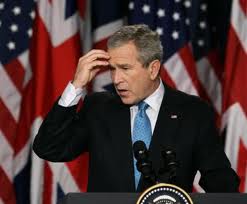
Edbauer also shows the ways in which affect is an impersonal and social force. (14) Since affect is something that precedes indexical qualification or cognitive interpretation “The visceral registering of excess is not necessarily a positive or negative phenomenon” (20). For these reasons Edbauer offers an alternative interpretation to understand why Bush’s fumbling speeches actually move people. She writes, “Before we can like, love, or loathe Bush—before the space of critique is even opened to us—we encounter his potential for affect(ation)” (16). We are “sensually involved” (16) in our experience of the Presidential event in such a way that we cannot stay removed.

Bush is an exemplary case for Edbauder because the so-called Bushisms are perfect demonstrations of the ways in which cultural theory’s representational or ideological explanations alone are insufficient. While Bush’s speaking ability in many ways is opposite of Teflon Ron’s, there is a similar dynamic at work in both. Although, Massumi’s citing of Oliver Sacks’ work challenges certain conceptions of Reagan as the Great Communicator, there is still an obvious difference in the polished or professional quality of their mannerisms. Massumi sees Reagan’s jerky movements and erratic rhythms of speech not as deficiencies but supplementary communicative forces. The affective events that implicate the audience in Reagan’s speeches were the reason why he could be so many things to so many people.

In many respects I find Massumi’s explanation for why Reagan moved people much more satisfactory than Edbauer’s explanation for Bush. While she does a great job of descriptively translating Bush’s idiosyncrasies into the vocabulary of affect theory, I’m still left wondering about exactly what is the specific connection between Bush’s jolts and the audience’s experience. Reagan was a very popular figure among people while Bush was seen in a less than favorable light. I’m not sure that Bush even really moved many people in his speeches.

Edbauer writes that, “Bush hacks our experience of narrative so easily, and with such a degree of intensity, because we are already in a kind of relationality with this executive body” (12). What sort of relationality are we already in with Bush? After listening to speeches from Bush during multiple campaigns and speech conferences are the interruptions really that interrupting? In other words, after Bushisms become a predictable part of his narrative do the “incorrect statements, tautologies, malapropisms, mispronunciations, and bewilderings remarks” (6) really “stage a jolt, causing intensity to build around them” (6)? Or are audiences so used to them that they glide over the surface of the skin relatively unnoticed? I think that Edbauer would say that the question is not whether they are cognitively registered but what these sticky associations do in experience of the Executive body. Is it just the fact that there are jolts and interruptions that “exposes the “productivity” of affect as a relational capacity” (7)? It’s difficult for me to reconcile the idea of affect as impersonal yet always already social.

It is here that I would like to compare Edbauer’s account of affect with a reading of Kristeva’s work on affect. I’m not sure exactly if Edbauer would disagree with all of it, but in the very least I think it offers an additional way of theorizing the question. I think that Kristeva’s reading of Plato’s chora from the Timaeus very closely resembles a lot of writings surrounding affect studies. The chora is the third principle that mediates the between matter and ideas. It is understood as a sort of receptacle or maternal space. Cecilia Sjoholm in “Kristeva & the Political” (2005) writes,

The chora is the space outside of being because it engenders transformation, mobility, motility, novelty, not a psychic site but a site of investments. Although it may be a container of affects and memories, it is not immediately translatable as the body, but rather the quasi-transcendental condition that makes corporeal mediation possible. The chora is a term of mediation irreducible to the terms of negativity and signification, not governed by law, but by a kind of organization. (19)

Much of this description of the chora is similar to the ways that Edbauer and Massumi describe the necessary condition of potentiality that allows affects to emerge, transfer, and transform. The above description attempts to distinguish the chora from theories of affect that conceive of affect in a reductionist manner as directly translatable to bodily experience.  I think that the ways that Edbauer describes the process of thinking-feeling demonstrates that Sjoholm’s distinction is not applicable to her account. Another one of Sjoholm’s definitions of the chora is strikingly similar to descriptions of affect, “that which cannot be named but shown in the form of rhythm, form, excess” (19). The chora is the space of generativity and poesis, the irreducible zone of indiscernability in which “the alterity of the other will make itself known through the excesses of signification known as the semiotic” (19).
Sara Ahmed’s essay “The Skin of the Community: Affect and Boundary Formation” in the collection “revolt, affect, collectivity: the unstable boundaries of kristeva’s polis” also offers an interesting account of affect to dovetail with Edbauer’s. I think her account can help explain some of the reasons why Bush moves people, but perhaps at the expense of giving up too much ground to explanations that exist within the realm of meaning. Ahmed writes,

The transformation of this or that other into a border object is over-determined. It is not simply any body that becomes the border; particular histories are reopened in each encounter, such that some bodies are already read as more hateful and disgusting than other bodies. Histories are bound up with attachments precisely insofar as it is a question of what sticks, of what connections are lived as the most intense or intimate, as being closer to the skin. Such an encounter moves us both sideways and forwards and backwards (the histories that are already in place that allow these associations and not others stick, and that allow them to surface in memory and writing) (106).

I find it hard to account for the reasons why Bush move’s people without bringing in the question of memories and histories in relation to the Executive body. It seems that Edbauer is so concerned with theorizing affect as purified from the realm of meaning that it comes at the expense of analyzing contextual factors influencing people’s experience of Bush. The sticky associations surrounding the speaker such can act as blockages or heightened sensitivities to the affective forces of a speech in ways that lead to dramatically different experiences on the part of the audience. While I agree with the importance in situating affect as preexisting the grid of ideological et. al. forces, I think it is likewise impossible to leave these factors out. I also do not mean to do an injustice to Edbauer’s theory in my reading of it and simply criticizing it for leaving something out. I think that this is a question she is conscious of when she writes, “this is not to say that the sensual experience of affect marks a return to a primal scene of origination” (16). Nonetheless, perhaps this is simply begging the entire question of affect studies that continues to haunt me. Which is how can a theory of affect toe the threshold between talking about something which exceeds qualification yet productively analyze its force without qualifying it. The aporia strikes back.


Labels: , , , , , , , , ,